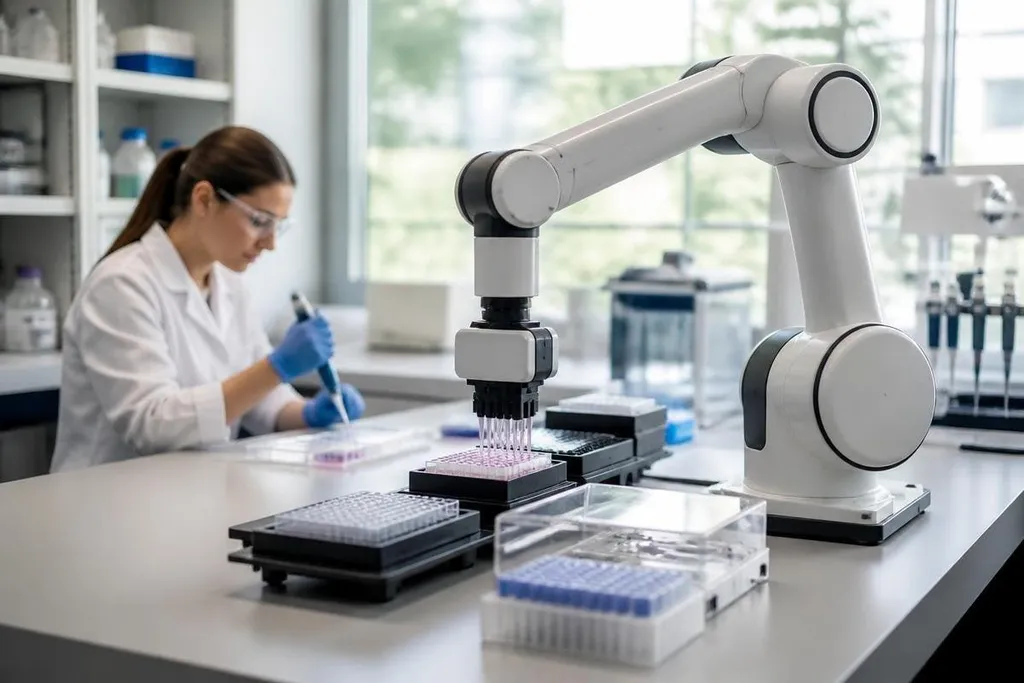
A laboratory robot can repeat the same pipetting, weighing, imaging, or sample transfer task for hours without changing its hand position. That matters as experiments use more samples, tighter timing, and smaller volumes than a person can handle comfortably.
The question is no longer whether a robot can move a plate. It is whether the machine can make lab work more repeatable without slowing scientists down.
Quick read
- Robots repeat routine steps with the same programmed motion.
- Automated records can show when a sample moved, where it went, and which setting was used.
- People still need to plan experiments, check results, and handle work that changes from one sample to the next.
Repetition is where robots help first
Many lab tasks follow a fixed sequence. The system can pick up a container, add a measured liquid volume, mix it, and place it in a set position. The software can repeat that sequence across a rack of samples.
The benefit comes from removing small changes between repetitions. A person may vary pressure, timing, angle, or pause length without noticing. A programmed arm follows the same path until someone changes the instructions.
That does not make an experiment correct by itself. A wrong volume, poor calibration, or blocked tip can affect every sample in the same run. The robot makes a process more consistent only when the setup and checks are sound.
More samples create more work
Modern lab work often depends on comparing many samples under controlled conditions. Each extra sample adds handling, labeling, timing, and record keeping. Those steps take time even when the scientific question is clear.
A liquid-handling system can move through a planned plate layout while software records the position of each sample. A vision system can check labels, liquid levels, or the location of objects before the next step.
These tools reduce manual handling, which gives laboratory staff more time for work that needs judgment. The machine also changes how a lab uses its working day. The system can run a prepared sequence outside normal staffed hours, but that only helps when the lab has safe procedures for loading, faults, waste, and alerts. Leaving a machine running is a process decision, not a feature that removes those duties.
Records matter as much as motion
Laboratory automation produces more than movement. The control software can store task order, timing, instrument settings, and error messages. That record helps a team check what happened when two runs produce different results.
This is useful for shared labs, where several people may handle the same project. A clear record reduces the need to remember which person moved a sample, when a step took place, or which version of a method was used.
The record still needs review. A log can show that a robot completed a command, but it cannot prove that the sample was clean, the reagent was suitable, or the result makes scientific sense.
A lab robot can repeat a measured pipetting motion, while a scientist checks the sample and result. A dated Robot24.com report can put that task beside its test record and the person responsible for each decision. That split matters when a clean run still needs human judgment.
Robots work best beside people
Laboratory work changes often. A researcher may need to adjust a method after an early result, handle an unusual sample, or inspect a problem that the software did not expect. Fixed automation can struggle when the task falls outside its programmed steps.
That is why flexible systems matter. A robot with interchangeable tools can handle different containers or instruments, while a person can decide when the method needs to change. Software interfaces also matter because staff need to edit a protocol without rebuilding the whole setup.
Safety remains part of the design. Moving arms, sharp tools, chemicals, heat, and biological material each need their own controls. A lab must define access rules, emergency stops, cleaning steps, and fault checks before it adds a robot to daily work.
A practical buying check
Before choosing a laboratory robot, check these points:
- Repeatable task: Write down the exact steps the robot will perform and the steps people will keep doing.
- Sample range: Check container sizes, liquid volumes, temperatures, and surface types against the machine’s working limits.
- Error handling: Confirm what happens after a blocked tip, dropped item, wrong barcode, or power loss.
- Records: Ask which actions, settings, alarms, and sample locations the software saves.
- Change time: Find out how long it takes to edit a method when the experiment changes.
- Human work: Keep a trained person responsible for setup, checks, cleaning, and review of results.
I’d choose a laboratory robot for a repeated process with clear checks, not for a task that changes every few minutes.
The next useful measure is not how many steps a robot can perform. It is how many runs stay correct after the method, sample type, and staff member change.